Archive

India

Well, here we go. 6 weeks into my India adventure, and that moment I knew would come, but that Goa had been coaxing me into believing might just yet be avoided, has finally happened. I’ve been the target of a walk by feel up.

I knew I was getting too comfortable. The ease of being in a beautiful, liberal, sea-side Indian town was just too good to be true.

If I had been in a crowded bus slammed between commuters, or even in a market in more northern conservative city, the incident might not have caught me so off guard. However, this happened mid-day, in plain sunlight, as I was venturing down an only somewhat busy market street making my way to the ice cream shop. I was in the heart of south Goa, on a touristy beach full of women in bikinis, men in Speedos, yoga studios, tattoo parlors, and discos. What then, you might ask, could I have possibly been doing to provoke this sudden male advance — Was it the way I had dressed? Did I make extended eye contact and imply that I was open to such an encounter? Hardly. Surrounded by strapless tops and thong bikini bottoms, I was clad in a tunic and long pants. And if you can imagine the focus I had on my sugary treat, you would know that there was no time for wandering eyes. Apparently, today my encounter was sheer luck.

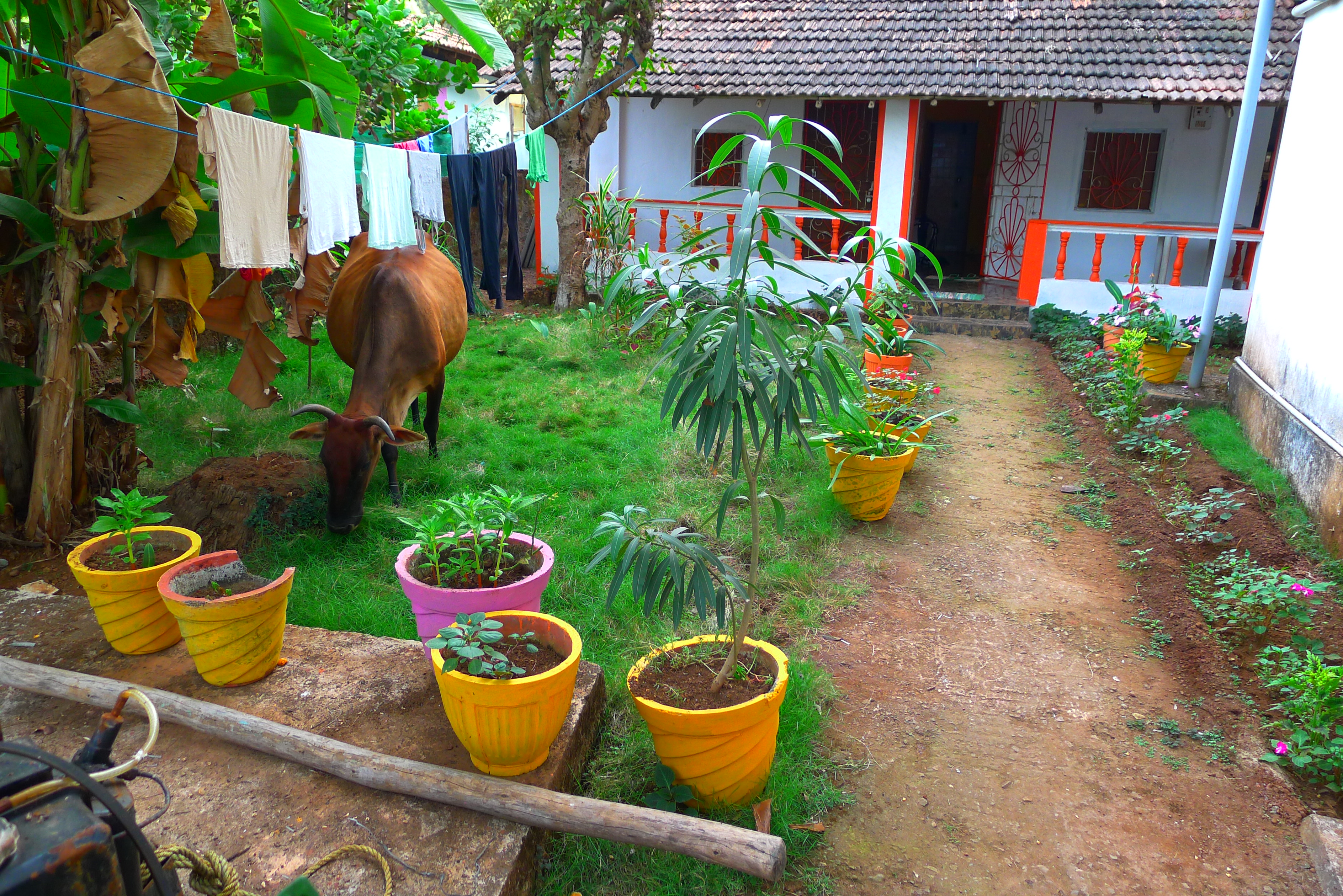
Of course this experience did not go over so well. I proceeded to berate this man with questions of how he could act in such a way. What would he have done if another man had done that same thing to his wife, sister, or mother? Finally seeing that my words were falling on drunken and deaf ears, I relented and went my own way. An Indian friend told me later that evening that I would have been in the right to hit him with my dusty, cow-poop covered shoe.

Lesson learned – when in India, always keep your dirtiest shoe easily accessible (either on your foot or in a purse if dressed to head out on the town), just in case of a walk by feel up. You never know when one might happen.

Flip Flops - the perfect protection.

I have just finished doing a yoga teacher training, which I think by default causes you to think of life in poetic parables… And if 30 straight days of yoga don’t do it, 30 straight days of India will.

To honor my month long commitment to 12 hours a day of yoga practice, meditation, and literary study, I brought some Yogi tea with me from NY. (If you don’t know Yogi tea, they have catchy little sayings on all of their tea bags.) Today’s says: “Life is a chance, Love is infinity, Grace is reality”. Thinking back to the loss of my friend Janika, inspires me to reinterpret the saying this way:

Love like your life depends on it, Live with grace, and Realize that your dreams have already been fulfilled.

I might just have to use that in one of my classes. Well, that is if I ever put this yoga thing to economic use.

Om Shanti

The Sickness of Duality

It is important to become aware of interdependence by realizing that a phenomenon occurs owning to multiple causes and conditions. Reducing it to one single factor would lead to a fragmentation of reality. Awareness of interdependence eventually brings about a lessening of violence. All the more so because when one places oneself in a wider context, one becomes less vulnerable to external circumstances and acquires a healthier judgment. Non-violence is not limited to an absence of violence, for it is a matter of active attitude, motivated by the wish to do others good. It is equivalent to altruism.

Selfless love is often misunderstood. It is not a question of neglecting oneself for others’ benefit. In fact, when you benefit others, you benefit yourself because of the principal of interdependence. I want to stress the importance of enlarging your mind and bringing the suffering of others onto yourself. Altruism changes our temperament, our humor, and our perceptions and allows us to develop a more serene, more even temperament. The opposite of altruism makes us vulnerable to external circumstances.

Egocentrism is against nature, for it ignores interdependence. It is an attitude that closes all the doors, whereas altruism develops profound vision. We should develop the feeling of belonging to a large human family. The causes and conditions of our future are largely in our hands.

“His Holiness the Dalai Lama – My Spiritual Autobiography”
Pg. 107 – Transforming the World

Everyone must assume a share of universal responsibility

I don’t believe in the creation of mass movements or in ideologies. And I do not appreciate the fashion of creating an organization in order to promote one idea or another, which implies that one small group is responsible for carrying out a given project, to the exclusion of everyone else. In the present circumstances, no one should assume that someone else will solve his problems. Everyone must assume his own share of universal responsibility. This way, as the number of concerned, responsible individuals increases –first dozens, then hundreds, then thousands even hundreds of thousands, the general atmosphere will be improved.

“His Holiness the Dalai Lama – My Spiritual Autobiography”
Pg. 117 – Transforming the World

When I began telling people that I had decided to come back to India for the months of January and February, they immediately began telling me how much the place has changed. We’ll see.

The last time I was in India, I was young, living in what was arguably a suboptimal situation, and spending my days tucked away in a small school in one of Delhi’s slums. I had moved to India to pickup some international development work experience before beginning graduate school. I was young, full of idealism and southern sensibilities, excited to begin work. After only 4 months, these things had been sucked out of me. I began to believe that human nature was inherently bad and corrupted by power. I began to believe that there were people who only wanted a better life position given to them free of charge. I began to believe that every man only saw a woman as an object to be possessed, and that every Indian was out to take me for all that I was worth just because I had blue eyes. For me, this was a shocking change of perception.

As I moved on and time passed, I could look back on my experience with softened eyes and pull out more of the positive moments and lessons. During my time, I had met some of the most sincere and generous people ever, mostly on trains and when traveling by myself. And I cannot forget that the girls with whom I worked had a strength and light about them that inspired me to no end. Unfortunately I still remember how that light seemed to be stamped out in most of the adults I encountered.

The juxtaposition of my experiences allowed me to become more confident in my beliefs on international development (that effective development can only take place with the direct involvement and ownership by local actors) and prematurely, but beneficially, knocked some of that young naiveté out of me. Never again would I encounter a place or culture and not look for the unapparent side, the full context. Never again would I take for granted the hope that is created by youth (in life experiences, not age). Never again would I be happy doing something that doesn’t make an impact.

Whether or not India has changed since the last time I was here, India has changed me. I think with that new consciousness, this time around will have to be different, and hopefully, will change me anew.

La Dolce Vita

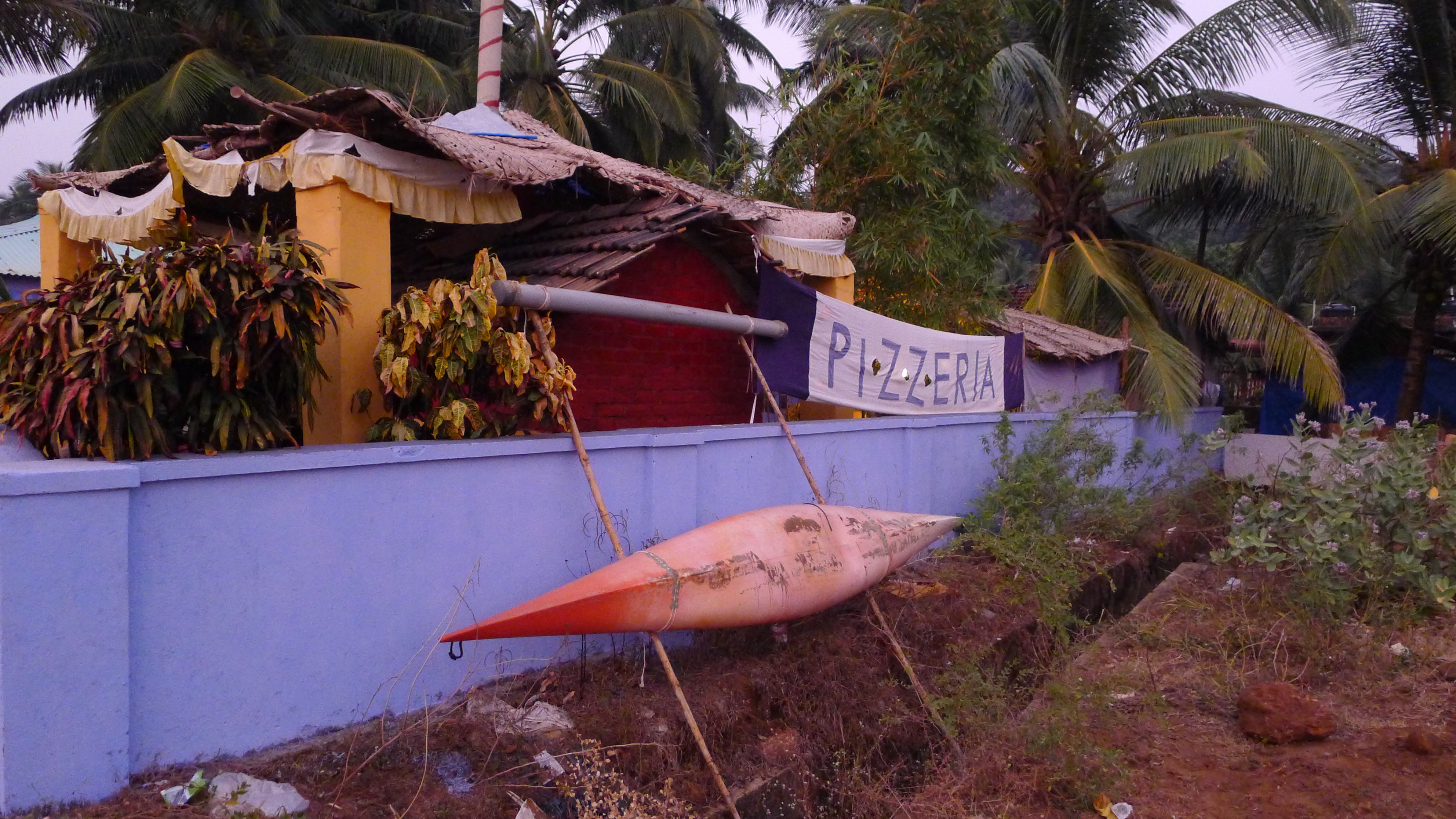
From this angle you might question the quality of La Dolce Vita’s pizza. Thoughts like… “maybe they put masala in the sauce?”, “perhaps the cheese is made with yak milk?”, or “is the crust really just a roti with improvised toppings?”… might pop into your head. But behind that sign is a real brick oven and in the kitchen there is the echo of beautiful northern Italian accents.  Yes, the vino is only Goan, but the menu, sauces, and service are full fledged Italian. In the small town of Agonda, where almost every restaurant has the same menu, the culinary options here are a quick breath of fresh air.